
The India-United States relationship is set to expand under the Donald Trump administration, but there could be some unease on issues like imports, tariffs and immigration, strategic affairs experts said after the Republican leader won the fiercely contested presidential election.
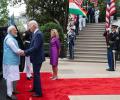
The change of heart in the US and India was propelled by the increased threat of China to both countries, explains Ambassador T P Sreenivasan.
India's National Security Advisor Ajit Doval held bilateral talks with US Director of National Intelligence Tulsi Gabbard, and chaired a conclave of top global intelligence chiefs focusing on strengthening cooperation in confronting various security challenges including terrorism and threats posed by emerging technologies. The meeting also focused on security in the Indo-Pacific region, cooperation to counter terror funding and money laundering, and issues relating to extradition and immigration.
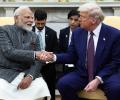
No one should make China an issue in their bilateral relations and their cooperation should not harm the interests of another country, the Chinese Foreign Ministry said on Friday reacting to queries on the meeting between Prime Minister Narendra Modi and United States President Trump.
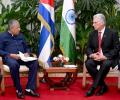
The warmth and respect for India were evident wherever I went and noticed how most Latin Americans have Indian gurus either directly or online and yoga was very much in vogue, observes Ambassador T P Sreenivasan.

To begin with, the consulate in Bengaluru will not offer visa services.
'It is typical of China's strategic deception of making virtue out of necessity,' observes Rup Narayan Das.
'But I don't think the government is in a great hurry to sign the BTA.'
Tahawwur Rana, accused in the 2008 Mumbai terror attacks, has been extradited to India after the US Supreme Court denied his last-ditch effort to avoid being sent back. Rana, a close associate of David Coleman Headley, another key conspirator in the attacks, was expected to be extradited "shortly" after his legal appeals failed. This decision comes after a multi-agency team from India traveled to the US to complete all necessary paperwork and legalities with the US authorities. Rana's extradition marks a significant development in the pursuit of justice for the victims of the Mumbai attacks.

As Donald Trump registered a historic comeback in the US presidential election, many former Indian diplomats on Wednesday concurred that the India-US ties will "continue to grow" from strength to strength, even as some of them cautioned that Trump is "highly unpredictable" and New Delhi will have to "wait and watch" to see what position he adopts going forward.
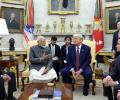
'By his words, actions, and body language during their joint press appearance wanted to convey his personal respect and, more broadly, his desire to work closely with India.'
While the capital spending is being maintained at 3.1 per cent of the GDP, a little more would have boosted economic growth even further, suggests Rajiv Memani.

Indian policymakers must realise that in buying small quantities of equipment, it becomes hard to start manufacturing them in India, explains Ajai Shukla.
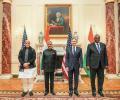
The pressure on India to take a hostile attitude towards Russia and China was not subtle, but it was guarded, observes Ambassador T P Sreenivasan after Monday's 2+2 ministerial meeting in Washington, DC.

Government representatives told a parliamentary panel that the US has not officially conveyed to India that it should cut tariffs by April 2.
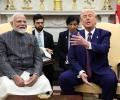
'Trump administration wanted a positive tone at this summit, but there was still some anxiety that there could be some awkward moments -- and there were not.'

New Delhi has reached out to Moscow while waiting for a new president in Washington. New Delhi knows well that in international relations, there are no permanent friends or foes, only permanent national interests, points out Dr Rup Narayan Das.

Jaishankar said, "The immediate part which awaits us is what we call the de-escalation, which is the build-up of forces along the Line of Actual Control."
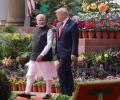
Prime Minister Narendra Modi will visit the US for a two-day working visit starting Wednesday. He will meet with President Donald Trump and engage in bilateral discussions on trade, investment, technology, defense cooperation, counterterrorism, Indo-Pacific security, and people-to-people relations. The visit is expected to further strengthen the India-US partnership.

He also said that it is more than a relationship between the two countries.

In the meeting with the Governor, the US Ambassador to India discussed a range of issues including investment in various fields.
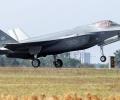
We need to equip the Indian Armed Forces, not 'commercial' as Trump wants, but 'operationally' looking at growing Chinese military capabilities, asserts Lieutenant General Prakash Katoch (retd).
The deportation of 104 Indian nationals from the US, followed by another 119 set to arrive in Amritsar on Saturday night, has sparked controversy in India over the treatment of returnees. The US government's intensified crackdown on undocumented immigrants has led to criticism of the use of handcuffs and shackles for deportees, even those who have committed no crimes beyond immigration violations. The issue has led to heated debates in the Indian Parliament, with opposition leaders demanding an inquiry into the deportation process. The Indian government is engaging with US officials to ensure the humane treatment of deportees, while also facing the challenge of reintegrating returnees into Indian society. The deportations highlight the ongoing tension between border control and human rights, and the complexities of US-India relations.

The Indian position on the Russia-Ukraine war and the unconditional treaty between China and Russia appear to have caused some ripples in India-US relations and led to a reappraisal of India's usefulness to the US in the eventuality of a conflict with China, notes Ambassador T P Sreenivasan.
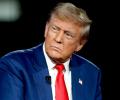
A leading expert predicts that the incoming Trump administration will likely continue its pro-India policies, including the Indo-Pacific strategy and Quad, but highlights potential challenges such as trade disagreements, immigration issues, and a possible quid pro quo for technology sharing. The expert also notes that the Trump 2.0 administration may prioritize great power politics over strategic altruism, potentially impacting human rights and religious freedom concerns.
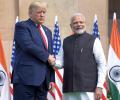
Prime Minister Narendra Modi will pay a two-day working visit to the US from February 12 during which he will meet President Donald Trump, the external affairs ministry announced. The visit will give further impetus and direction to India-US bilateral relationship. Prior to his US visit, Modi will be in France from February 10-12 to co-chair the AI Action Summit with French President Emmanuel Macron. He will also visit Cadarache, the site of the International Thermonuclear Experimental Reactor of which India is a partner. During his visit to France from February 10-12, Modi and Macron will also address the India-France CEOs forum. The prime minister and Macron will travel to Marseille where they will inaugurate the Consulate General of India. The leaders will also visit the war cemetery and pay tribute to the sacrifices made by Indian soldiers in World War 1. Modi and Macron will visit Cadarache, the site of the International Thermonuclear Experimental Reactor (ITER). There has been a very close rapport between Trump and Modi, dating back to the US leader's first term. There is a clear convergence of interests between the two countries in several areas, including trade, investment, technology, defense cooperation, counterterrorism, Indo-Pacific security, and people-to-people relations.
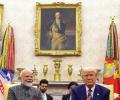
'Modi's intention was to create goodwill that will allow India to be seen by Trump as more than just a bad tariff problem.' 'He succeeded brilliantly on that count but none of these wins are unfortunately permanent.' 'Modi will have to do this again and again if Trump's grievances are to be durably assuaged.'
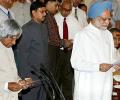
The landmark India-US civil nuclear deal of 2008, brokered during Manmohan Singh's tenure as Prime Minister, is seen as a crowning achievement in his foreign policy legacy. The agreement ended India's nuclear isolation, fostered a strategic partnership with the US, and opened doors to advanced technologies and defense cooperation. This historic deal also laid the groundwork for India's engagement with the global nuclear community.

The EAM when asked about his view of the world at present, said it would be "very grim forecast, for the next five years".
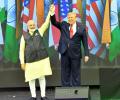
President Trump made these remarks on Monday while talking to reporters aboard Air Force One on his way back to Joint Base Andrews from Florida.

India and the US on Thursday said they are looking forward to the reconvening of the India-US Trade Policy Forum later this year to further enhance trade relationship and identify new areas for engagement.

Over the years, India has enjoyed bipartisan support in the US and this asset must be kept intact and nurtured through across the board political and civil society engagement, suggests former foreign secretary Shyam Saran.

Although India-US relations have strengthened significantly in recent years, partly because of the security situation in the region, the Indian policy establishment would have to be prepared to protect India's interests in a world that could get more unpredictable.
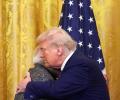
'He needs to see results while he is in office.'
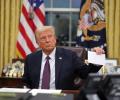
It would be a challenge to India's policy makers how to deal with Trump so that mutual economic growth remains sustained and mutual understanding on global issues are not hampered, observes Dr Rajaram Panda.

China has reiterated its plan to build the world's largest dam over the Brahmaputra River in Tibet, near the Indian border. The Chinese Foreign Ministry has assured that the project, estimated to cost around USD 137 billion, will not have any negative impact on downstream countries, India and Bangladesh. The ministry has stated that the project has undergone rigorous scientific verification and will be conducive to disaster prevention and mitigation, as well as climate change response. India has expressed concerns about the dam, raising the issue during talks with the visiting US National Security Advisor, Jake Sullivan. China has maintained that the project will not negatively affect the lower reaches and has committed to maintaining communication with downstream countries.

Modi conveyed his New Year greetings to the US president, the PMO said. During the conversation, the prime minister noted that India-US relations, which are built on trust, mutual respect and understanding, "have grown from strength to strength", it said.

The Biden administration's failure in stopping two major wars and several minor ones was seen as a major disaster by many Americans and the world at large, observes Ambassador T P Sreenivasan.
The relationship between the US and India has been very productive, in particular on the trade and technology front, and 2023 can be considered the best year historically for bilateral ties, according to a former top American trade official. Arun Kumar, an Indian-American, who served as the assistant secretary of Commerce for Global Markets and director general of the US and Foreign Commercial Service (USFCS) during the Obama administration, said this during an interview with PTI in Washington. "Looking back on 2023, it was a very productive year for the US-India relationship, by many accounts the best year historically," he said.
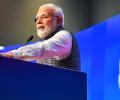
The Indian Diaspora has been able to carve a niche in their adopted countries as a result of their talent, perseverance and hardworking nature, asserts Rup Narayan Das.
